Water
[Esta página está disponible en castellano]
Efficient management of water resources is essential to ensure sustainability and water availability for future generations. Climate change and increasing water demand pose a threat to water availability through longer and more intense drought periods, as well as extreme weather events such as floods. It has become more important than ever to implement management practices that ensure the responsible use of this resource.
Accounting has proven to be a useful tool across different fields. In the case of water, it plays a crucial role in its management by providing detailed and transparent information about the availability and use of water resources. This enables decision-makers to formulate more effective strategies for integrated water resource management.
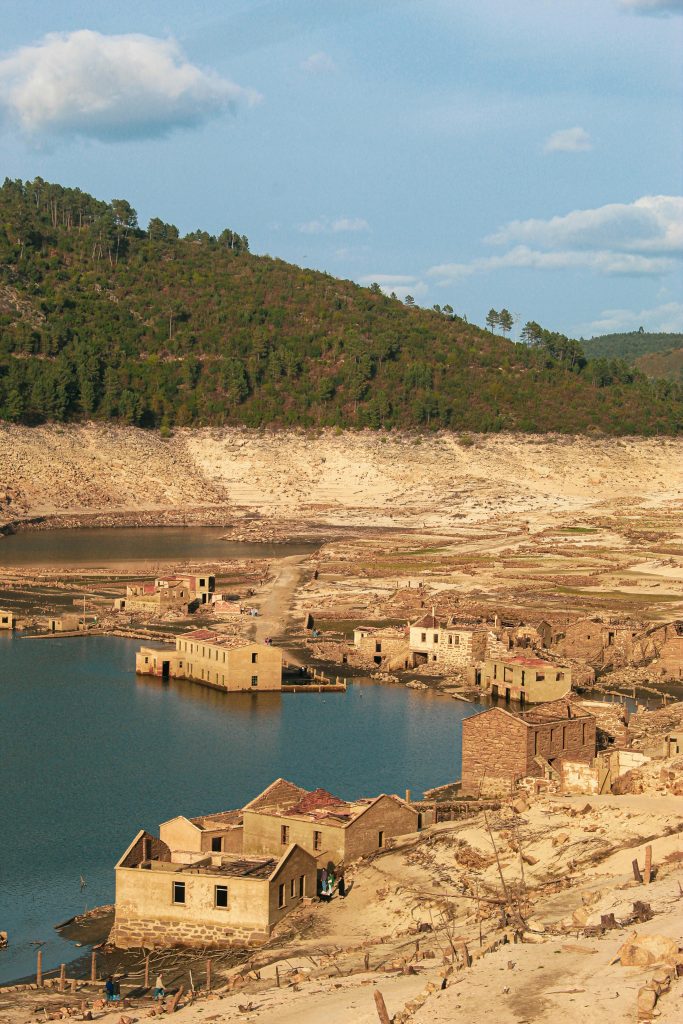
How can accounting help manage water resources?
I attempt to answer this question in this article published in The Conversation.
Scientific Articles Published on Water:
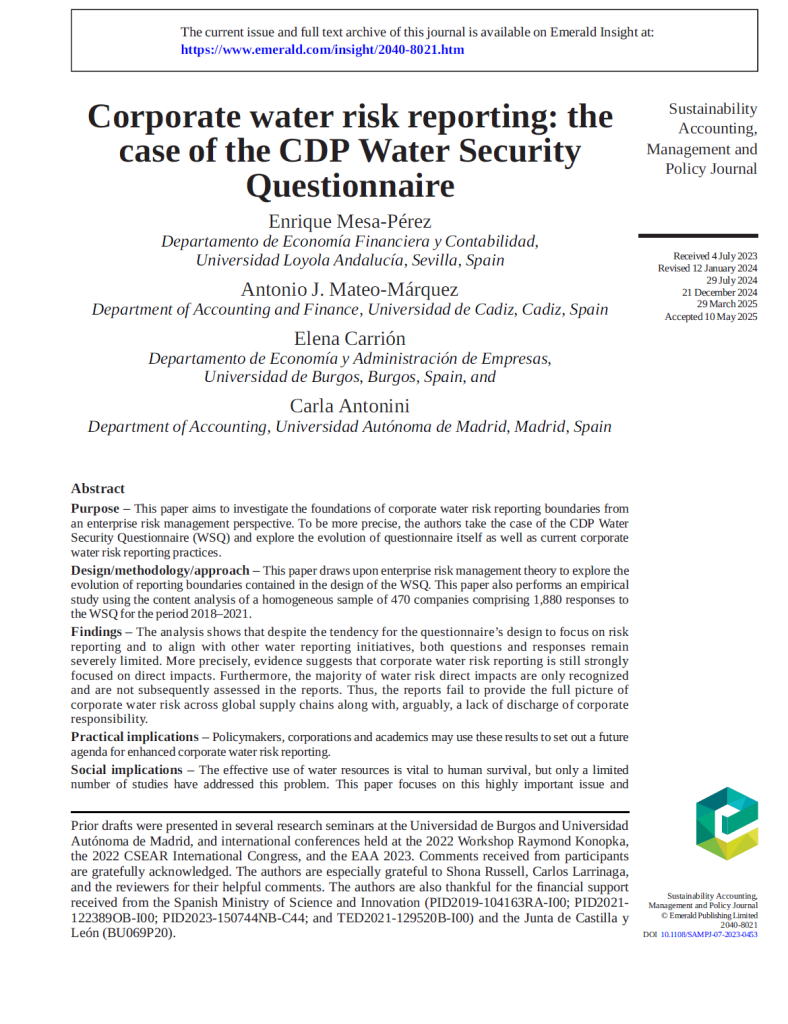
Corporate water risk reporting: the case of the CDP Water Security Questionnaire
2025. Sustainability Accounting, Management and Policy Journal
This paper aims to investigate the foundations of corporate water risk reporting boundaries from an enterprise risk management perspective. To be more precise, the authors take the case of the CDP Water Security Questionnaire (WSQ) and explore the evolution of questionnaire itself as well as current corporate water risk reporting practices.
This paper draws upon enterprise risk management theory to explore the evolution of reporting boundaries contained in the design of the WSQ. This paper also performs an empirical study using the content analysis of a homogeneous sample of 470 companies comprising 1,880 responses to the WSQ for the period 2018–2021.
The analysis shows that despite the tendency for the questionnaire’s design to focus on risk reporting and to align with other water reporting initiatives, both questions and responses remain severely limited. More precisely, evidence suggests that corporate water risk reporting is still strongly focused on direct impacts. Furthermore, the majority of water risk direct impacts are only recognized and are not subsequently assessed in the reports. Thus, the reports fail to provide the full picture of corporate water risk across global supply chains along with, arguably, a lack of discharge of corporate responsibility.
Policymakers, corporations and academics may use these results to set out a future agenda for enhanced corporate water risk reporting.
The effective use of water resources is vital to human survival, but only a limited number of studies have addressed this problem. This paper focuses on this highly important issue and concludes that the definition of corporate water risk reporting boundaries is relevant to improvements in water security.
To the best of the authors’ knowledge, this paper provides the first comprehensive assessment of corporate water risk reporting boundaries.
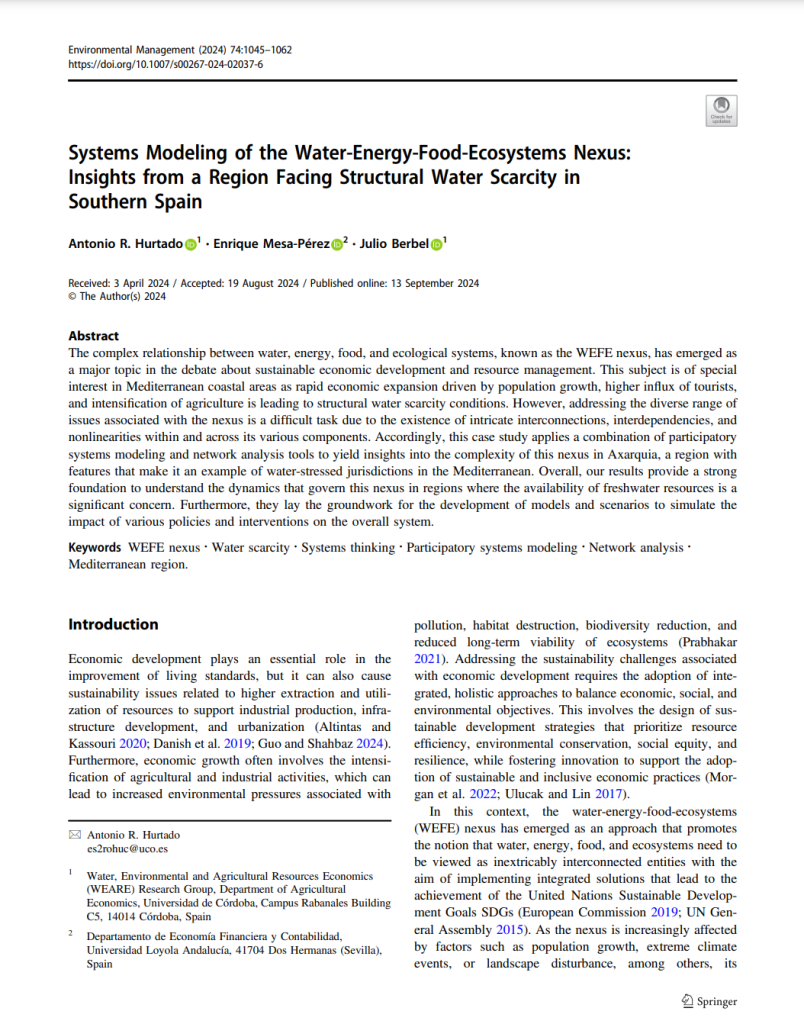
Systems Modeling of the Water-Energy-Food-Ecosystems Nexus: Insights from a Region Facing Structural Water Scarcity in Southern Spain
2024. Environmental Management
The complex relationship between water, energy, food, and ecological systems, known as the WEFE nexus, has emerged as a major topic in the debate about sustainable economic development and resource management. This subject is of special interest in Mediterranean coastal areas as rapid economic expansion driven by population growth, higher influx of tourists, and intensification of agriculture is leading to structural water scarcity conditions. However, addressing the diverse range of issues associated with the nexus is a difficult task due to the existence of intricate interconnections, interdependencies, and nonlinearities within and across its various components. Accordingly, this case study applies a combination of participatory systems modeling and network analysis tools to yield insights into the complexity of this nexus in Axarquia, a region with features that make it an example of water-stressed jurisdictions in the Mediterranean. Overall, our results provide a strong foundation to understand the dynamics that govern this nexus in regions where the availability of freshwater resources is a significant concern. Furthermore, they lay the groundwork for the development of models and scenarios to simulate the impact of various policies and interventions on the overall system.
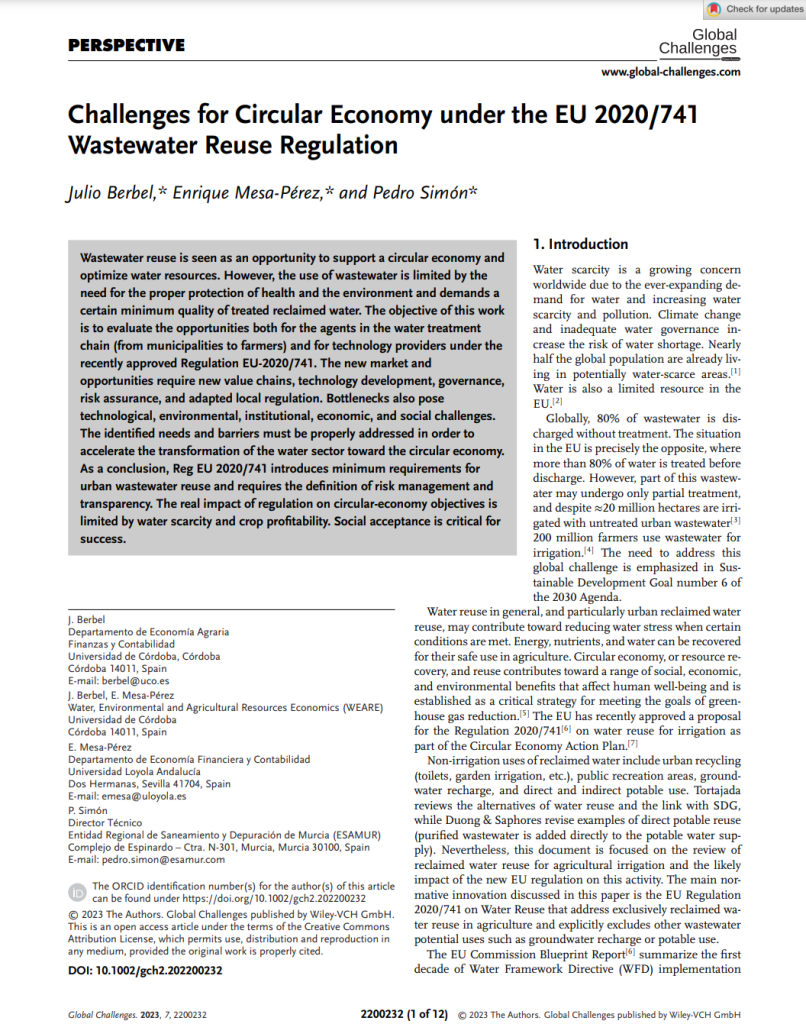
Challenges for Circular Economy under the EU 2020/741 Wastewater Reuse Regulation
2023. Global Challenges
Wastewater reuse is seen as an opportunity to support a circular economy and optimize water resources. However, the use of wastewater is limited by the need for the proper protection of health and the environment and demands a certain minimum quality of treated reclaimed water. The objective of this work is to evaluate the opportunities both for the agents in the water treatment chain (from municipalities to farmers) and for technology providers under the recently approved Regulation EU-2020/741. The new market and opportunities require new value chains, technology development, governance, risk assurance, and adapted local regulation. Bottlenecks also pose technological, environmental, institutional, economic, and social challenges. The identified needs and barriers must be properly addressed in order to accelerate the transformation of the water sector toward the circular economy. As a conclusion, Reg EU 2020/741 introduces minimum requirements for urban wastewater reuse and requires the definition of risk management and transparency. The real impact of regulation on circular-economy objectives is limited by water scarcity and crop profitability. Social acceptance is critical for success.
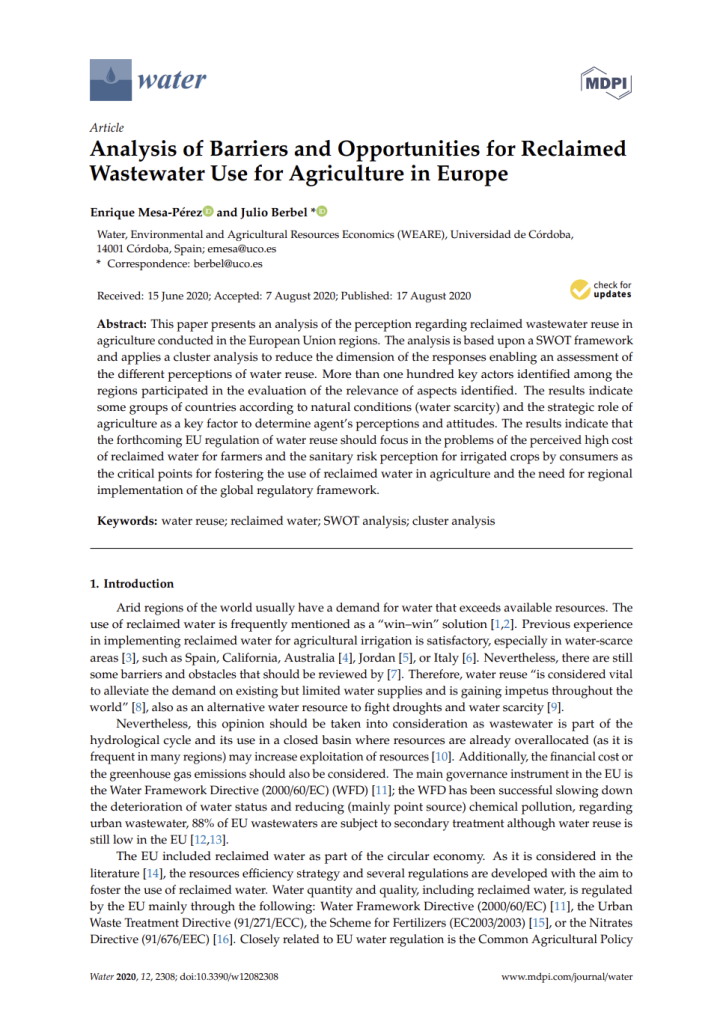
Analysis of Barriers and Opportunities for Reclaimed Wastewater Use for Agriculture in Europe
2020. Water
This paper presents an analysis of the perception regarding reclaimed wastewater reuse in agriculture conducted in the European Union regions. The analysis is based upon a SWOT framework and applies a cluster analysis to reduce the dimension of the responses enabling an assessment of the different perceptions of water reuse. More than one hundred key actors identified among the regions participated in the evaluation of the relevance of aspects identified. The results indicate some groups of countries according to natural conditions (water scarcity) and the strategic role of agriculture as a key factor to determine agent’s perceptions and attitudes. The results indicate that the forthcoming EU regulation of water reuse should focus in the problems of the perceived high cost of reclaimed water for farmers and the sanitary risk perception for irrigated crops by consumers as the critical points for fostering the use of reclaimed water in agriculture and the need for regional implementation of the global regulatory framework.
Other publications on water issues:
2020. SWOT Analysis of Reclaimed Water Use for Irrigation in Southern Spain